
Is the FFA just looking for empty jackets? That is a question many long time supporters and observers are asking about the State of Florida’s decision to use tax dollars to cover FFA membership dues for every student enrolled in agricultural education through the Future Farmers of America (FFA).
On the surface, this policy looks like a win—eliminating financial barriers, expanding access, and echoing Florida FFA’s stated commitment to “diversity in its membership, leadership, and staff” and to reducing barriers to participation. But beneath that rhetoric lies a thorny set of legal, constitutional, and policy questions about whether taxpayer money should underwrite private nonprofit memberships.
FFA Membership and the Florida Farm Bill
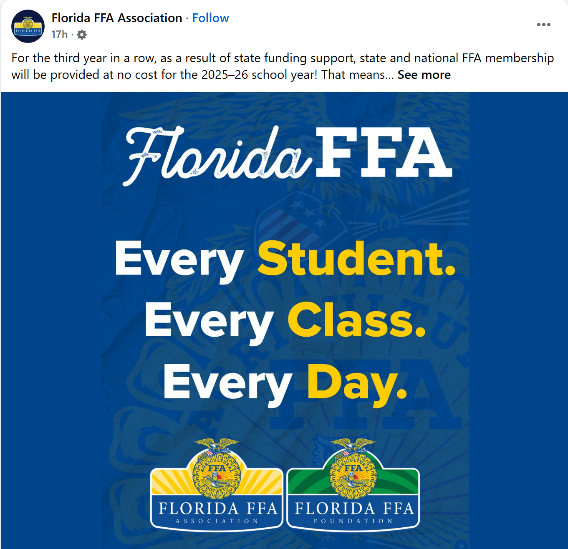
The 2025 Florida Farm Bill directs the Department of Agriculture and Consumer Services to “extend state and national Future Farmers of America opportunities to any public school student enrolled in agricultural education, at little or no cost to the student or school district.”
In practice, the state writes a check covering dues for every agricultural student in Florida. Deceptively branded as “scholarships for annual dues and educational opportunities”, the label intends to align with Florida FFA’s inclusivity goals, such as broadening access and ensuring “every student has a chance to belong.” But the statute makes it clear: this is not a needs-based scholarship program. It is universal coverage, whether or not a student—or their parents—want it.
Public Purpose or Private Subsidy?
Florida’s Constitution prohibits public funds from being used for purely private purposes. This means the state cannot subsidize memberships in private organizations, no matter how laudable.
While supporters may argue that funding the membership dues for a private organization serves a public purpose, this rationale does not hold up to the sunlight for which Florida is famous. It looks less like education spending and more like another social experiment back-door subsidy at taxpayer expense to inflate Florida’s FFA membership roster. It begs important questions related to the governance of the underlying nonprofit membership and the voluntary nature FFA membership and both the student’s and the parents’ role in deciding whether FFA membership makes sense for that student.
Nonprofit Law Complications
Under Florida’s Not For Profit Corporation Act (Chapter 617), nonprofit members have statutory rights: voting, access to records, and governance participation (unless restricted by bylaws). By automatically enrolling minors as “members,” the state may be binding them to a private corporation without their—or their parents’—knowledge or consent.
This bulk purchase of memberships blurs lines Florida law has long tried to keep distinct. While Florida FFA highlights inclusion and belonging, the reality is that the state is effectively subsidizing the enrollment of tens of thousands of minors into a private corporation.
Parental Consent and Student Choice
Florida Parents’ Bill of Rights underscores that parents must have a say in their child’s educational and extracurricular involvement. School districts routinely require signed permission slips for club participation. Yet under this arrangement, students are automatically swept into FFA’s rolls, regardless of interest.
Even if a student never wears the blue jacket or attends an FFA meeting, dues are still paid on their behalf. This raises profound concerns—not only about parental consent but also about the freedom of association. Shouldn’t joining a private organization, even one rooted in agricultural education, remain a voluntary decision?
Transparency and Accountability
Florida FFA frequently touts its commitment to transparency in governance and reducing barriers to membership. But what about accountability when state tax dollars are funneled into private organizations? Florida law requires nonprofits that receive state funds for dues to open their records to the public.
Does this requirement now apply to Florida FFA—and possibly even to National FFA? If yes, that could fundamentally alter how these nonprofits operate. If no, then Florida taxpayers are subsidizing memberships in an organization shielded from scrutiny. Neither outcome inspires confidence.
Other Concerns
- Waste: Many students won’t use the membership taxpayers fund.
- Precedent: If FFA dues can be covered, why not 4-H, Future Business Leaders, or other private student organizations?
- Blurred Lines: Embedding itself in a nonprofit’s membership model, the state undermines the distinction between public programs and private associations.
The Bigger Question
No one doubts FFA’s value. Florida FFA has long provided opportunities for leadership, agricultural education, and service. Yet its DEI messaging—commitments to “every student, every class, every day”—speaks to an agenda that is more about social engineering than it is about agricultural education. Regardless of the agenda, both legal limits and constitutional questions remain.
By stretching the definition of “public purpose” and sidelining parental rights, Florida has created a model that may be politically popular today but is legally vulnerable tomorrow. More importantly, it risks setting a precedent where the state subsidizes private memberships simply because the cause is good.
The bottom line: Is this really the best use of taxpayer dollars—or a troubling precedent that blurs the line between public education, parental choice, and private association?